
Jawaharlal Nehru Technological University Kakinada (JNTUK) is established in the year 2008 vide ACT NO. 30 OF 2008 by the State of ANDHRA PRADESH. The University grew out of the College of Engineering Vizagapatnam founded by the Government of the composite Madras State in the year 1946. Spread over a sprawling campus of 100 acres in the port city of Kakinada, the college became a constituent of JNTU, Hyderabad in 1972. Subject to the trifurcation of the JNTU Hyderabad, it was notified as JNTUK Kakinada by the act of legislature in 2008.
The jurisdiction of JNTU Kakinada extends over the districts of East Godavari, Kakinada, Konaseema, West Godavari, Eluru, NTR, Krishna, Guntur, Palnadu, Bapatla and Prakasam. The University has 159 affiliated colleges under the jurisdiction of these 11 districts. The University serves approximately 2.3 lakh students across more than 50 bachelor programs, over 120 master programs, and various Ph.D. programs. It offers Engineering and Pharmacy courses in both Under Graduate and Post Graduate Programs, as well as Management programs. The University and colleges are governed by the rules and guidelines provided by the Higher Education Department of AP and AP State Council for Higher Education from time to time. JNTUK has produced highly professional and competitive engineers by infusing greater quality and content into the curriculum and educating students with appropriate skills suitable for a rapidly challenging industrial scenario.
To improve the Quality of Technical Education, faculty are encouraged to participate actively in a number of national programmes like the Teacher Quality Improvement Programme, University-Industry Interaction through consultancy, Continuing Education Programmes, and Expansion of infrastructure facilities for Emerging Technologies. University has established higher learning institutes such as Institute of Science and Technology (IST), School of Food Technology(SFT) and School of Management Studies(SMS).
The University is also offering Research Programmes in all disciplines of engineering and sciences both Full time and External registrations. With many professional colleges coming up in private sector, the need has arisen to improve the quality of teaching. It necessitates providing continuous refresher courses to the teachers for updating and acquiring additional skills in new areas.
The University Board of Studies is composed with reputed persons from Higher Learning Institutes and industry and revises its course structure and syllabi regularly for every three years. In 2015, JNTUK started offering customized MOOCS with the support from senior faculty of IITs, NITs and industry persons and offered various courses to its affiliated colleges. To enhance and focus on research, the University has established a Research and Development Cell and Research Centres in affiliated colleges and provided Scholarships for fulltime Research Scholars to increase number of in-house researchers.
The University is primarily promoting quality of education in the areas of Science, Technology, Engineering, and Management (STEM) as four academic pillars of education, to excel in teaching, learning, research, consultancy, and placements through innovative practices with a global perspective.
The University is moving forward with a mission of promoting excellence, access, inclusion, and relevance in quality in Science, Technology, Engineering, and Management, namely
Academic Excellence, Research & Innovation, People Technology & Creativity, Social & Environmental Responsibility, Human & Intellectual Knowledge.
The University instills the thought that it is fully capable of orienting knowledge and information in a scientific manner in the minds of the young people. JNTUK aims at helping the students population avail quality education with latest technologies in an IT-savvy environment and core engineering industries. It gives the students an opportunity to study the subject they want. They can choose from numerous undergraduate, postgraduate and Doctoral programs of different disciplines like Engineering, Management, Pharmacy, Food Technology, Biotechnology etc.. Interactive classrooms, well equipped laboratories, sports facility of national standards, natural beauty, places with spiritual essence and the entire site filled with artifacts not only provide the best learning platform to the students but also ensures that they are made.
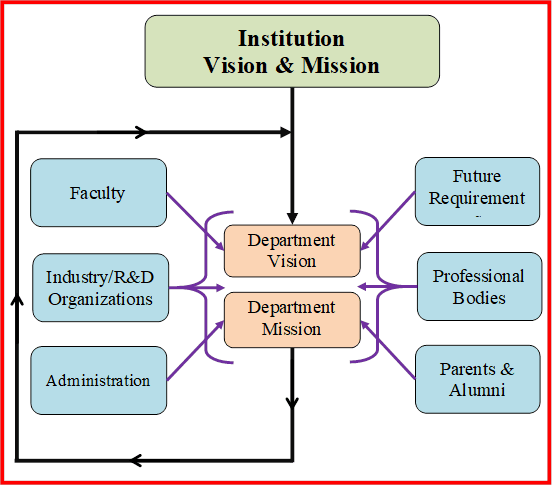
The Vision, Mission, Goals and Objectives reflect the nature of Governance and decision making of the University. The Governance of the institution is carried out with the support of statutory bodies constituted as per the state university norms. The participation of Teachers at different administrative tasks and actions is quite effective as expressive from that the Head of Institution with a great level of satisfaction whilst this decentralized Governance is easing out the responsibilities.
JNTUK has formulated a comprehensive and progressive two-decade strategic plan, in tune with its Vision and Mission, to become a leading teaching-cum-research Institute through a standard system of education, with more emphasis on fundamentals, after an exhaustive self-examination by all its stakeholders, including external experts from HEIs. Smooth functioning of any institution depends on the resolutions and minutes discussed in respective bodies/ cells/ committees. The University has constituted different cells and committees for the successful implementation of the resolutions. JNTUK provides welfare measures for the benefit of the faculty and the supporting staff. The IQAC directorate along with the Directorate of Academic Planning within the University monitors and reviews the Teaching-Learning process regularly. Further, for the development of the institution in respect of quality enhancement, value addition and sustainability, the conceptual ideas obtained from the stakeholders are analyzed and synthesized and formulated, which in turn tailored to requirements.
An exclusive directorate “Directorate of Empowerment of Women and Grievances” was established by Jawaharlal Nehru Technological University Kakinada to empower and safeguard the rights of female fraternity of the University. Jawaharlal Nehru Technological University, Kakinada provides the following
facilities for the safety and security of girl students.
JNTUK supports two best practices as:
STRATEGIC GROWTH PLANS 2018-23
JNTUK has formulated a comprehensive and progressive two-decade strategic plan, in tune with its Vision and Mission, to become a leading teaching-cum-research Institute through a standard system of education, with more emphasis on fundamentals, after an exhaustive self-examination by all its stakeholders, including external experts from HEIs.
STRATEGY- I : To impart Personnel Skills and Ethical Values for Sustainable Development of the Nation.
STRATEGY-II : To create Research & Industry oriented centers of excellence in all engineering disciplines.
1. Provide ample need and merit based assistantships for PG, PhD and direct PhD Scholars.
2. Enhance students’ academic success through a rich, caring and challenging educational environment.
3. Enhance students’ employability through on-campus finishing school by improving students’ communication skills, soft skills and professional skills.
4. Special attention for full participation of women students and socially/academically disadvantaged students.
5. Opportunities for leadership development, ethical practices, entrepreneurship and social commitment.
6. Product Incubation Center and seed money for students’ works towards product development and innovation.
STRATEGY -III : To be a renowned IPR generator and repository for innovative technologies.
1. Faculty recruitment and retention plans including competitive, merit and outcome-based incentives and rewards.
2. Attract, appoint and retain a minimum of ten senior faculty members who have potential to lead, research, develop and attain the highest honors in their discipline. Vast alumni network will be tapped in this regard.
3. Build a cohesive team to achieve academic, research, and consultancy targets.
4. Build great teams for Industry-Institution Interaction, Academic and sponsored Research, Institutional Networking, Consultancy and extension activities etc.
STRATEGY -IV : To develop Research and Industry oriented technical talent.
1. Increased Industry-Institution Interaction through MOUs for mutually beneficial relationships with Industries and public enterprises in the areas of research, development, training, and technology transfer.
2. Increased Internal Revenue Generation to facilitate enhancement of facilities and outcome-based compensation.
STRATEGY -V : To benchmark globally the academic & research output.
1. Opportunities for UG, PG, and PhD students to participate in industrial research, product development assignments, consultancy, etc.
2. Continuously improve faculty and staff competence through regular deputation to seminars, workshops, conferences, summer/winter schools, faculty and staff development programs etc., both in India and Abroad.
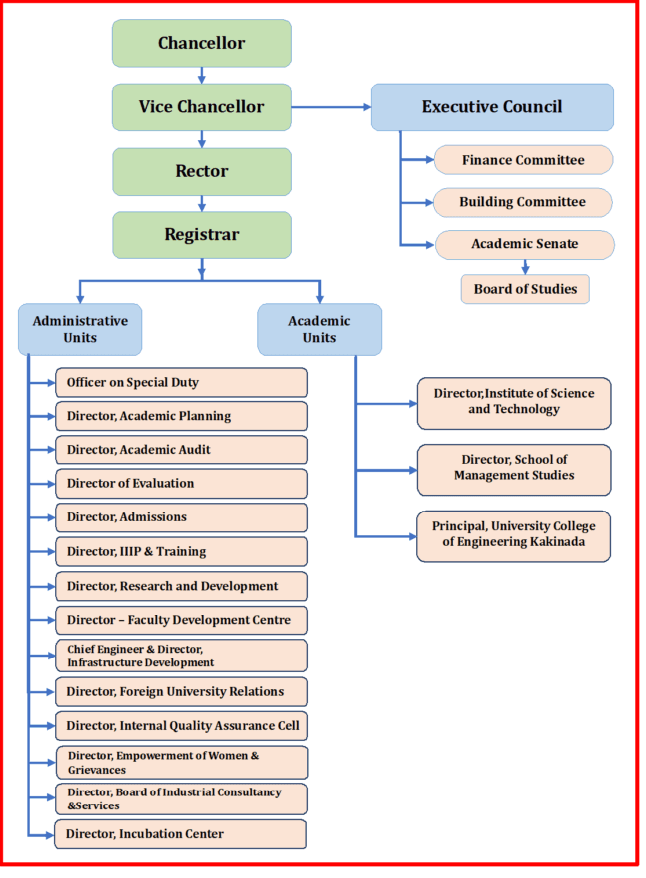
JNTUK has in place all the bodies and committees that enable participation of all stakeholders in decision making and implementation process. As per JNTUK, there is an established academic and administrative hierarchy set up with well-defined roles and responsibilities of administrators, teachers, and employees. Policies are framed for various aspects of administration. There are policies and guidelines like Research Promotion Policy, IPR Policy, and Consultancy Policy, etc.
There are two types of functional units: Academic and Administrative in order to achieve the vision, mission, and strategic planning of the University:
Academic Functioning:
JNTUK has various schools which work together to meet interdisciplinary approach for scholarly learning and innovation. Each institute is headed by a Director/Principal having overall leadership responsibility for the School. The Director/Principal is also responsible for policy level involvement and decisions pertaining to Programs of the concerned Institutes.
Director/Principal of various institutions have operational leadership responsibility for day to day administration and functioning of classes and courses in different programmes including quality and effectiveness of Teaching-Learning, monitoring progress of the students, interacting with the parents, managing the examinations, etc.
For academic monitoring and approval of Programmes, the University has two statutory bodies:
Board of Studies (BOS) that looks after all curricular matters of the respective programmes/departments. The BoS updates the existing program curriculum and also initiate proposal for introduction of any new program. The minutes of the BOS are presented before the Academic Council for consideration and approval.
The Academic Senate is the principal academic body of the University for the approval of all academic matters.
Administrative Functioning
JNTUK has an Administrative Unit, headed by a registrar which functions in close collaboration with the Academic Unit for the routine operations of the University.
Under the Registrar, Joint Registrar (JR) and Deputy Registrar (DR) monitor and maintain accounts, engineering and infrastructure, personnel services, purchasing, warehousing, equipment repair, printing, etc.
The University has a Finance Committee to consider the accounts and financial estimates of the University and submit them for approval to the EC which is headed by the VC of the University and the Registrar as member secretary.